
gemini-cli
Google's own terminal coding agent — Gemini models only, and personal Google sign-in no longer reaches it
What is gemini-cli?
Google's own agent for the terminal: it reads a repository, edits files, runs shell commands, and can ground an answer in a live Google Search without extra setup. A read-only plan mode drafts the work before anything is written, a policy file settles in advance which tools may run, and one extension can install MCP servers, commands, subagents, skills and hooks together. It talks only to Gemini models, so it is a poor fit if you expect to switch providers or work offline — and since 18 June 2026 a personal Google sign-in no longer reaches it, leaving an API key, Vertex AI, or a Code Assist Standard or Enterprise licence.
What can you do with gemini-cli?
- Point it at a repo and give it standing instructions — It starts in the working directory, and
--include-directories ../lib,../docspulls in sibling folders. Standing instructions live in GEMINI.md files — one in your home directory, any in the workspace and its parent folders, plus more picked up mid-task the first time a tool touches a directory — and every file found is concatenated and sent with each prompt, not just at startup. - Make it plan before it touches anything — Plan mode is a read-only state whose only write is a Markdown plan you review and edit; Shift+Tab cycles between it, the default confirm-every-step mode, and auto-edit. Policy rules can settle allow, deny or ask per tool ahead of time, and an administrator's rules outrank a user's.
- Roll back a turn, or the whole session —
/rewind, or Esc twice, lists earlier turns and offers to undo the chat, the agent's file edits, or both. A separate checkpointing setting goes further and snapshots the project into a shadow Git repository before each edit. - Look things up mid-task — Google Search grounding and a page-fetching tool are built in, so the agent can check current library documentation or an unfamiliar error while it works instead of reasoning from what the model memorised.
- Install a whole toolset in one command —
gemini extensions install <github url>adds an extension that bundles MCP servers, custom slash commands, subagents, agent skills and hooks together — one install rather than many edits to settings.json, which matters when a team shares a setup. - Run it from a script or a pull request —
gemini -p "…" --output-format jsonreturns the reply, token counts and any error as one object,stream-jsonemits events line by line for long jobs, and Google's run-gemini-cli Action wires the same binary into PR review and issue triage.
Before you choose gemini-cli
- A personal Google account stopped working as a sign-in route on 18 June 2026, yet the README and setup guide shipped in the 0.55 line still recommend it, so newcomers follow the docs into a dead login.Reported in#27998
- Only Google's own Gemini models are supported: as of the 0.55 line there is no route to an OpenAI-compatible endpoint or to Ollama, and a locally run model can only be used to make routing decisions.Reported in#5938
Star history
17 Aug to 28 Aug · +190
Frequently asked questions
Is gemini-cli free for commercial use?
gemini-cli is released under the Apache-2.0 licence — OSI-approved open source, which permits commercial use.
How can gemini-cli be deployed?
gemini-cli is available as Runs locally.
Documentation
Reproduced from the google-gemini/gemini-cli README, published under Apache-2.0. Read the original ↗
Gemini CLI



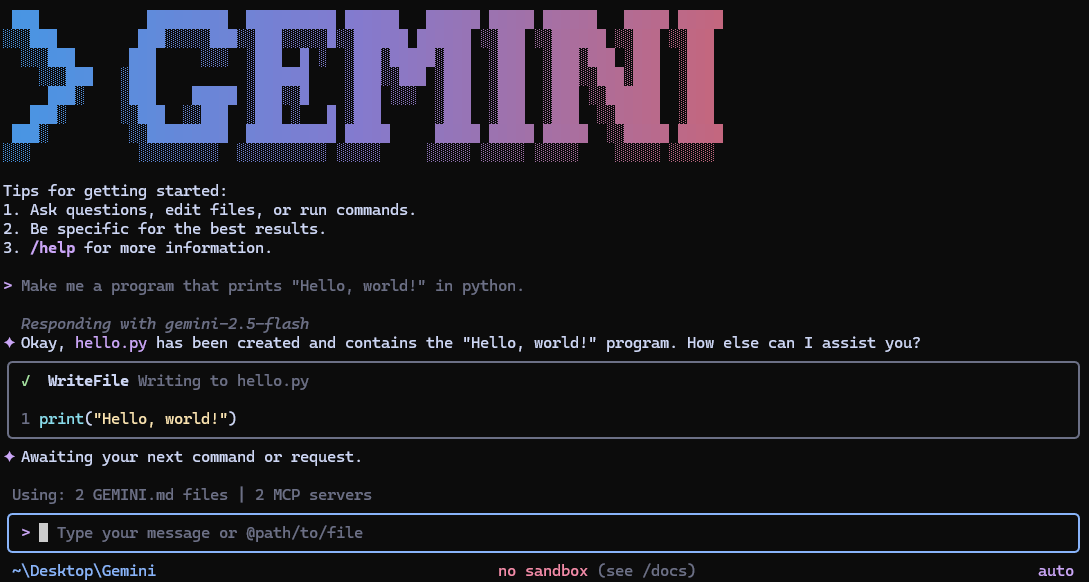
Gemini CLI is an open-source AI agent that brings the power of Gemini directly into your terminal. It provides lightweight access to Gemini, giving you the most direct path from your prompt to our model.
Learn all about Gemini CLI in our documentation.
🚀 Why Gemini CLI?
- 🎯 Free tier: 60 requests/min and 1,000 requests/day with personal Google account.
- 🧠 Powerful Gemini 3 models: Access to improved reasoning and 1M token context window.
- 🔧 Built-in tools: Google Search grounding, file operations, shell commands, web fetching.
- 🔌 Extensible: MCP (Model Context Protocol) support for custom integrations.
- 💻 Terminal-first: Designed for developers who live in the command line.
- 🛡️ Open source: Apache 2.0 licensed.
📦 Installation
See Gemini CLI installation, execution, and releases for recommended system specifications and a detailed installation guide.
Quick Install
Run instantly with npx
# Using npx (no installation required)
npx @google/gemini-cli
Install globally with npm
npm install -g @google/gemini-cliInstall globally with Homebrew (macOS/Linux)
brew install gemini-cliInstall globally with MacPorts (macOS)
sudo port install gemini-cliInstall with Anaconda (for restricted environments)
# Create and activate a new environment
conda create -y -n gemini_env -c conda-forge nodejs
conda activate gemini_env

# Install Gemini CLI globally via npm (inside the environment)
npm install -g @google/gemini-cli
Release Channels
See Releases for more details.
Preview
New preview releases will be published each week at UTC 23:59 on Tuesdays. These
releases will not have been fully vetted and may contain regressions or other
outstanding issues. Please help us test and install with preview tag.
npm install -g @google/gemini-cli@previewStable
- New stable releases will be published each week at UTC 20:00 on Tuesdays, this
will be the full promotion of last week’s
previewrelease + any bug fixes and validations. Uselatesttag.
npm install -g @google/gemini-cli@latestNightly
- New releases will be published each day at UTC 00:00. This will be all changes
from the main branch as represented at time of release. It should be assumed
there are pending validations and issues. Use
nightlytag.
npm install -g @google/gemini-cli@nightly📋 Key Features
Code Understanding & Generation
- Query and edit large codebases
- Generate new apps from PDFs, images, or sketches using multimodal capabilities
- Debug issues and troubleshoot with natural language
Automation & Integration
- Automate operational tasks like querying pull requests or handling complex rebases
- Use MCP servers to connect new capabilities, including media generation with Imagen, Veo or Lyria
- Run non-interactively in scripts for workflow automation
Advanced Capabilities
- Ground your queries with built-in Google Search for real-time information
- Conversation checkpointing to save and resume complex sessions
- Custom context files (GEMINI.md) to tailor behavior for your projects
GitHub Integration
Integrate Gemini CLI directly into your GitHub workflows with Gemini CLI GitHub Action:
- Pull Request Reviews: Automated code review with contextual feedback and suggestions
- Issue Triage: Automated labeling and prioritization of GitHub issues based on content analysis
- On-demand Assistance: Mention
@gemini-cliin issues and pull requests for help with debugging, explanations, or task delegation - Custom Workflows: Build automated, scheduled and on-demand workflows tailored to your team’s needs
🔐 Authentication Options
Choose the authentication method that best fits your needs:
Option 1: Sign in with Google (OAuth login using your Google Account)
✨ Best for: Individual developers as well as anyone who has a Gemini Code Assist License. (see quota limits and terms of service for details)
Benefits:
- Free tier: 60 requests/min and 1,000 requests/day
- Gemini 3 models with 1M token context window
- No API key management - just sign in with your Google account
- Automatic updates to latest models
Start Gemini CLI, then choose Sign in with Google and follow the browser authentication flow when prompted
geminiIf you are using a paid Code Assist License from your organization, remember to set the Google Cloud Project
# Set your Google Cloud Project
export GOOGLE_CLOUD_PROJECT="YOUR_PROJECT_ID"
gemini
Option 2: Gemini API Key
✨ Best for: Developers who need specific model control or paid tier access
Benefits:
- Free tier: 1000 requests/day with Gemini 3 (mix of flash and pro)
- Model selection: Choose specific Gemini models
- Usage-based billing: Upgrade for higher limits when needed
# Get your key from https://aistudio.google.com/apikey
export GEMINI_API_KEY="YOUR_API_KEY"
gemini
Option 3: Vertex AI
✨ Best for: Enterprise teams and production workloads
Benefits:
- Enterprise features: Advanced security and compliance
- Scalable: Higher rate limits with billing account
- Integration: Works with existing Google Cloud infrastructure
# Get your key from Google Cloud Console
export GOOGLE_API_KEY="YOUR_API_KEY"
export GOOGLE_GENAI_USE_VERTEXAI=true
gemini
For Google Workspace accounts and other authentication methods, see the authentication guide.
🚀 Getting Started
Basic Usage
Start in current directory
geminiInclude multiple directories
gemini --include-directories ../lib,../docsUse specific model
gemini -m gemini-2.5-flashNon-interactive mode for scripts
Get a simple text response:
gemini -p "Explain the architecture of this codebase"For more advanced scripting, including how to parse JSON and handle errors, use
the --output-format json flag to get structured output:
gemini -p "Explain the architecture of this codebase" --output-format jsonFor real-time event streaming (useful for monitoring long-running operations),
use --output-format stream-json to get newline-delimited JSON events:
gemini -p "Run tests and deploy" --output-format stream-jsonQuick Examples
Start a new project
cd new-project/
gemini
> Write me a Discord bot that answers questions using a FAQ.md file I will provide
Analyze existing code
git clone https://github.com/google-gemini/gemini-cli
cd gemini-cli
gemini
> Give me a summary of all of the changes that went in yesterday
📚 Documentation
Getting Started
- Quickstart Guide - Get up and running quickly.
- Authentication Setup - Detailed auth configuration.
- Configuration Guide - Settings and customization.
- Keyboard Shortcuts - Productivity tips.
Core Features
- Commands Reference -
All slash commands (
/help,/chat, etc). - Custom Commands - Create your own reusable commands.
- Context Files (GEMINI.md) - Provide persistent context to Gemini CLI.
- Checkpointing - Save and resume conversations.
- Token Caching - Optimize token usage.
Tools & Extensions
- Built-in Tools Overview
- MCP Server Integration - Extend with custom tools.
- Custom Extensions - Build and share your own commands.
Advanced Topics
- Headless Mode (Scripting) - Use Gemini CLI in automated workflows.
- IDE Integration - VS Code companion.
- Sandboxing & Security - Safe execution environments.
- Trusted Folders - Control execution policies by folder.
- Enterprise Guide - Deploy and manage in a corporate environment.
- Telemetry & Monitoring - Usage tracking.
- Tools reference - Built-in tools overview.
- Local development - Local development tooling.
Troubleshooting & Support
- Troubleshooting Guide - Common issues and solutions.
- FAQ - Frequently asked questions.
- Use
/bugcommand to report issues directly from the CLI.
Using MCP Servers
Configure MCP servers in ~/.gemini/settings.json to extend Gemini CLI with
custom tools:
> @github List my open pull requests
> @slack Send a summary of today's commits to #dev channel
> @database Run a query to find inactive users
See the MCP Server Integration guide for setup instructions.
🤝 Contributing
We welcome contributions! Gemini CLI is fully open source (Apache 2.0), and we encourage the community to:
- Report bugs and suggest features.
- Improve documentation.
- Submit code improvements.
- Share your MCP servers and extensions.
See our Contributing Guide for development setup, coding standards, and how to submit pull requests.
Check our Official Roadmap for planned features and priorities.
📖 Resources
- Free Course - Learn the basics.
- Official Roadmap - See what’s coming next.
- Changelog - See recent notable updates.
- NPM Package - Package registry.
- GitHub Issues - Report bugs or request features.
- Security Advisories - Security updates.
Uninstall
See the Uninstall Guide for removal instructions.
📄 Legal
- License: Apache License 2.0
- Terms of Service: Terms & Privacy
- Security: Security Policy
Other options in Coding Agents
 opencodeCoding Agents
The distinguishing idea is that everything is declared rather than hard-wired: you define named agents in JSON or a markdown file, give each one its own model and its own per-tool permissions — allow, ask or deny for reading, editing and running commands — and switch between them with a keystroke. Two built-in primary agents ship this way, one with full access and one that asks before editing or running anything. It is MIT and provider-agnostic, but it moves fast and it recently changed hands, so old links and pinned versions go stale quickly.
 Codex CLICoding Agents
It works the way the other terminal agents do — read the repository, propose changes, run commands — but the boundary it enforces is unusual: on macOS and Linux it uses operating-system sandboxing to restrict which files and commands the agent can reach, so the limit does not depend on the model choosing to respect it. Sign-in runs through a ChatGPT plan or an OpenAI API key, which is the trade: the code is Apache-2.0, the model behind it is not the open part.
 PonytailCoding Agents
Ask an agent for a date picker and you can get a dependency, a wrapper component, a stylesheet and a conversation about time zones, when the browser has had `<input type="date">` for years. Ponytail is a single skill aimed at that habit: it pushes the agent towards the smallest thing that works, and towards not writing anything when the platform already provides it. What makes it worth a look rather than a joke is that the maintainers measured it — twelve real tasks on a real repository, with and without the skill — and published the method alongside the numbers, including a note that an earlier, more flattering figure was the per-task ceiling rather than the average.